
 Sex Toys For Men
  Sex Toys for Women
  Sex Toys for Couples
  Anal toys
  Fit it
 Sex Ed
 Deals
Deals About Us
 Contact Us
 Apr/29/2023
 2271
2271 9 min read
 12 Yoga Poses That May Support Better Sex and Intimacy

Our articles may contain affiliate links - if you enjoy our content, support us by shopping through them! We earn a small commission at no extra cost to you. Learn more here.
Our articles may contain affiliate links - if you enjoy our content, support us by shopping through them! We earn a small commission at no extra cost to you. Learn more here.
Yoga will not magically transform your sex life, but it can improve some of the physical and psychological skills that make sexual activity more comfortable: mobility, balance, strength, breathing, body awareness and relaxation. A 2024 systematic review and meta-analysis of randomized trials found a small improvement in sexual function among adults who practiced yoga, but the evidence was low certainty and most participants were women. That makes yoga promising, not a guaranteed treatment.
The best approach is to practice yoga because it helps your body feel stronger, more mobile and more present. If those changes also make sex more comfortable or enjoyable, consider that a useful bonus.
Can Yoga Really Improve Your Sex Life?
Possibly, but avoid dramatic claims. The 2024 meta-analysis included 10 randomized trials and 730 adults. Yoga was associated with a small improvement in sexual-function scores compared with no intervention, while the authors emphasized that larger, higher-quality trials are still needed.
That is very different from saying one pose increases libido, guarantees orgasm or fixes sexual dysfunction. Sexual function is influenced by health, medication, hormones, pain, stress, relationships, sleep and many other factors.
Mobility Can Make Some Positions More Comfortable
Hip, hamstring and spinal mobility can make certain sexual positions easier to enter and maintain. More range of motion is not always better, though. Comfortable control matters more than extreme flexibility.
Strength and Stability Can Reduce Fatigue
Core, leg, shoulder and glute strength can help with positions that require supporting body weight or maintaining a posture. Again, the goal is not acrobatics. If a position hurts, modify it or choose another one.
Breathing and Body Awareness May Help You Stay Present
Yoga often pairs movement with slower breathing and attention to physical sensations. Those skills can be useful when anxiety or distraction makes it hard to stay connected to what feels good.
Yoga Is Not a Treatment for Every Sexual Problem
If you have persistent genital pain, erectile problems, loss of sensation, pelvic-floor symptoms or ongoing difficulty with desire or orgasm that bothers you, yoga should not replace medical evaluation. Exercise may support well-being, but sexual symptoms can have medical causes.
4 Strength and Stability Yoga Poses
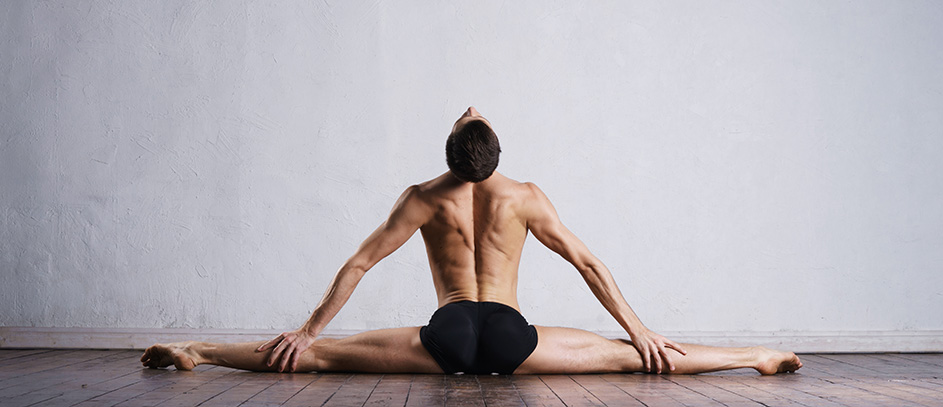
1. Warrior II
Warrior II develops leg endurance, hip stability and balance. Stand with your feet wide, turn the front foot outward, bend the front knee and extend the arms in opposite directions. Keep the front knee tracking comfortably over the foot instead of forcing it inward.
Why it may help: Strong legs and controlled hip positioning can make standing, kneeling and supported positions easier to maintain.
2. Bridge Pose
Lie on your back with your knees bent and feet planted, then lift your hips while keeping your neck relaxed. Bridge strengthens the glutes and posterior chain while gently opening the front of the hips.
Why it may help: Glute and pelvic stability support many forms of movement. If you have neck or back problems, modify the range or ask a qualified instructor for help.
3. Low Plank or Forearm Plank
A plank builds trunk and shoulder endurance. Keep your body in a line you can control and stop before your lower back begins to sag. A knee-supported version is completely valid.
Why it may help: Core endurance can make weight-bearing positions less tiring and help you change positions with more control.
4. Chair Pose
From standing, bend your knees and send your hips back as if sitting into a chair, keeping your weight balanced through your feet. Reach your arms forward or overhead if your shoulders allow it.
Why it may help: Chair pose challenges the thighs and glutes without requiring floor work, making it useful for general lower-body endurance.
4 Mobility and Relaxation Poses

5. Cat-Cow
Start on hands and knees. Move slowly between a rounded spine and a gently extended spine while breathing. Do not force your neck into an extreme position.
Why it may help: Cat-cow encourages gentle spinal movement and can help you notice how your pelvis moves with your spine.
6. Supported Happy Baby
Lie on your back and bring your knees toward your chest. Hold behind the thighs, shins or feet depending on your mobility. Let the hips open without pulling the knees aggressively toward the floor.
Why it may help: This position can gently open the hips and inner thighs. Use a strap if reaching your feet creates strain.
7. Sphinx or Gentle Cobra
Lie on your stomach and support your upper body on your forearms for sphinx, or use your hands for a small cobra. Keep the movement comfortable rather than pushing for a dramatic backbend.
Why it may help: Gentle spinal extension and chest opening can counter long periods of sitting and improve comfort in prone positions.
8. Butterfly Pose
Sit with the soles of your feet together and let your knees fall outward. Keep your spine comfortable and avoid pressing the knees toward the floor.
Why it may help: Butterfly provides a gentle inner-thigh and hip stretch without requiring advanced flexibility.
4 Partner Yoga Poses for Connection
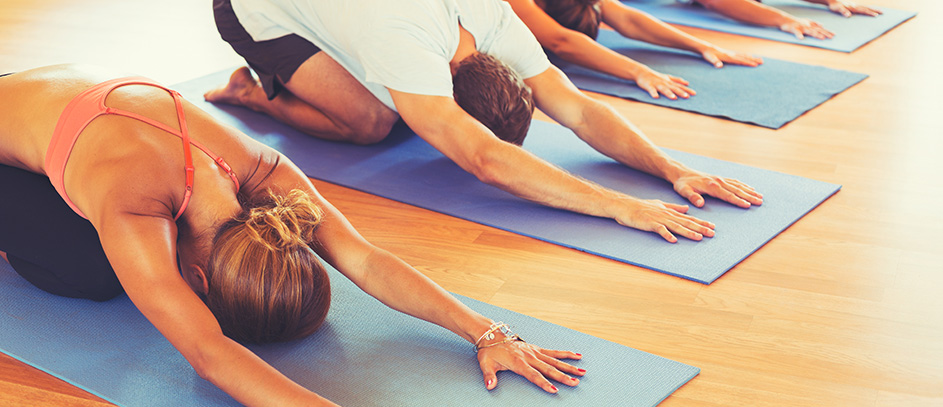
9. Back-to-Back Seated Breathing
Sit comfortably with your backs touching and breathe at your own pace. You do not need to synchronize perfectly. The point is to notice the shared contact without turning it into a performance.
Why it may help: This is a low-pressure way to practice presence and nonverbal connection.
10. Partner Seated Forward Fold
Sit facing one another with your legs in a comfortable position. Hold hands or forearms and alternate who leans back gently while the other folds forward. Keep the range modest and communicate constantly.
Why it may help: Partner stretching requires trust and feedback, two skills that also matter during sex.
11. Supported Yab-Yum Seat
One partner sits comfortably while the other sits facing them with close body contact. You do not need to wrap legs around a partner or force the hips into a particular angle. Cushions can make the position much more accessible.
Why it may help: Eye contact, breathing and close contact can make the pose feel intimate without requiring sexual activity.
12. Legs-Up-the-Wall Together
Lie side by side with your legs resting against a wall. This is less of an athletic partner pose and more of a shared recovery position.
Why it may help: It encourages slowing down. Relaxation and reduced performance pressure can be just as valuable to intimacy as flexibility.
💡 PRO TIP: Do not turn partner yoga into a flexibility contest. The most useful skill is telling your partner what feels comfortable, what needs to change and when you want to stop.
How Often Should You Practice?
You do not need daily yoga to notice benefits. Two or three consistent sessions per week can improve familiarity with the movements, while even shorter mobility sessions may help you feel less stiff. The research on sexual function has used different programs and durations, so there is no evidence-based “sex yoga” schedule that works for everyone.
Progress should be measured in comfort, control and consistency rather than how deep you can stretch.
Can Yoga Increase Libido?
There is no single yoga pose proven to switch libido on. Some people may notice improved sexual interest when exercise reduces stress, improves mood or makes them feel more comfortable in their body. Others may notice no change at all.
If low desire is persistent and distressing, consider factors such as medication, hormonal changes, depression, anxiety, pain, sleep and relationship context. Yoga can be supportive, but it is not a substitute for addressing the underlying cause.
Yoga, Pelvic Floor and Sexual Function
Some yoga poses involve the trunk, hips and pelvic floor indirectly, but yoga should not be confused with individualized pelvic-floor therapy. A pelvic floor can be weak, overactive, painful or poorly coordinated. Constantly telling everyone to “strengthen” it can be unhelpful when relaxation is actually the missing skill.
If penetration is painful, you have pelvic pressure, urinary symptoms or difficulty relaxing the pelvic floor, a pelvic-health clinician can assess what is happening more accurately than a generic pose list.
Using Yoga to Make Sex More Comfortable
Think about the limitation you actually want to address. If knees get sore, use cushions and choose positions that reduce kneeling. If hips feel tight, gentle mobility may help. If upper-body fatigue is the problem, strength work may be more useful than stretching. If anxiety is the main barrier, breathing and slower transitions may matter most.
You can also choose sexual positions that fit the body you have today instead of trying to train your body into a position you do not enjoy.
Who Should Modify or Skip Certain Poses?
Pregnancy, recent surgery, joint instability, osteoporosis, back or neck problems, high blood pressure and other medical conditions can change which yoga positions are appropriate. Follow guidance from your clinician or a qualified yoga professional who understands your limitations.
Stop if you experience sharp pain, numbness, dizziness or symptoms that feel medically concerning.
A Simple 20-Minute Yoga Routine for Sexual Comfort
If you want a practical sequence, start with two minutes of slow breathing, move through cat-cow for gentle spinal mobility, spend time in Warrior II and chair pose for lower-body endurance, use butterfly and supported happy baby for hip mobility, then finish with bridge and legs-up-the-wall. Move slowly and keep each position within a range you can control.
This routine is not a medical protocol. It is simply a balanced way to combine mobility, strength and down-regulation without turning the session into a flexibility challenge.
Yoga Before Sex vs. Yoga as Regular Exercise
A short stretch before sex may help you feel less stiff, but the more meaningful physical benefits come from regular practice over time. Strength, balance and mobility adapt through repeated training rather than one dramatic pre-date session.
If yoga immediately before sex makes you tired or lightheaded, separate the activities. You do not need to turn every wellness habit into foreplay for it to support your sexual well-being.
What the Research Does Not Tell Us Yet
Most studies in the recent meta-analysis involved women, and the trials varied in yoga style, duration and population. That means we cannot confidently rank individual poses, predict who will benefit most or claim that yoga works equally well for every sexual concern.
The useful takeaway is modest: structured yoga may improve sexual-function scores a little for some adults. It is a supportive practice, not a replacement for evidence-based treatment when pain, erectile problems, low desire or orgasm difficulties are persistent and distressing.
The Takeaway: Yoga Can Support Intimacy, Not Guarantee It
Yoga may offer a small sexual-function benefit for some adults, and the physical skills it develops can make movement and body awareness easier. The strongest reason to practice, however, is that you enjoy how it makes your body feel.
Use these 12 poses as a mobility, strength and connection routine, not as a promise of a particular orgasm, libido level or bedroom performance.
FAQs About Yoga and Sexual Function
A 2024 meta-analysis found a small improvement in sexual function compared with no intervention, but the evidence was low certainty and heavily weighted toward women. More high-quality research is needed.
No. Use blocks, straps, cushions, wall support and smaller ranges of motion. Yoga is not a test of flexibility.
There is no reliable timeline. Improvements in strength, mobility or relaxation may develop over weeks of consistent practice, but changes in sexual function are individual and not guaranteed.
Not reliably. Low desire can have psychological, relationship, hormonal, medication-related and medical causes. Yoga may support well-being, but persistent distress deserves individualized evaluation.
It can feel intimate if both people want that, but it does not have to be sexual. Decide together what the practice means and keep consent separate from assumptions about what happens afterward.
 Previous article